
How fast can Tacoma Porta Pros respond to an emergency?
Fast is relative to what broke and how many people need a working toilet tonight. For a single displaced household or a small shelter, emergency porta potty rental usually means a standard unit delivered same day, sometimes within hours if the truck is already routed through Tacoma. For a larger event, like a multi-block water main failure or a flood that takes out a neighborhood's septic systems at once, the first priority is triage: how many people, how long, and whether there's power for a handwashing station rental or if it needs a standalone unit.
A portable toilet rental fleet gets staged based on OSHA 1926.51(c), which sets facility ratios by headcount, one toilet for 20 workers or fewer, scaling up from there. Disaster response crews and volunteer labor count the same way construction crews do. If the deployment supports agricultural or farm labor displaced by the event, field sanitation falls under a different standard, OSHA 1928.110, which requires one facility per 20 workers within a quarter mile walk. Either way, the math starts with a headcount, not a guess, and how many porta potties do i need walks through the same ratio in more detail.
What sanitation gets deployed first in a disaster?
Standard units go down first because they're fast to place and need no hookup. A standard porta potty rental carries a 60 to 70 gallon holding tank and stands about 92 inches tall on a 44 by 48 inch footprint, small enough to fit a driveway, a parking strip or a gravel shoulder. When septic systems are the failure point, not just a shortage of toilets, septic pumping service trucks come in to empty tanks that are backing up or flooded, and a holding tank rental can bridge a household or a facility until the system is repaired.
Accessibility doesn't get skipped because it's an emergency. ADA Standards section 213.2 requires that where portable units are clustered, at least 5 percent must be accessible, never fewer than one, so an ada accessible porta potty belongs in the first wave of deployment, not an afterthought added later. For sites without running water, a portable sink rental or hand sanitizer station rental covers the gap, though 29 CFR 1910.141(d)(2) is clear that soap and towels or a hand drying device are what satisfy a washing requirement, not sanitizer alone. If cleanup work involves paints, coatings or chemical residue left behind by flooding, OSHA 1926.51(f)(1) requires washing facilities for that specific exposure.
Larger relief operations, shelters, staging areas, distribution points, often need more than toilets. Tacoma Porta Pros also delivers temporary fence rental to secure a site, light tower rental where power is out and crews are working after dark, and storage container rental to hold donated supplies or equipment out of the weather. A roll-off dumpster rental clears storm debris fast, which matters because OSHA 1926.25 requires scrap and debris to be cleared from active work areas.
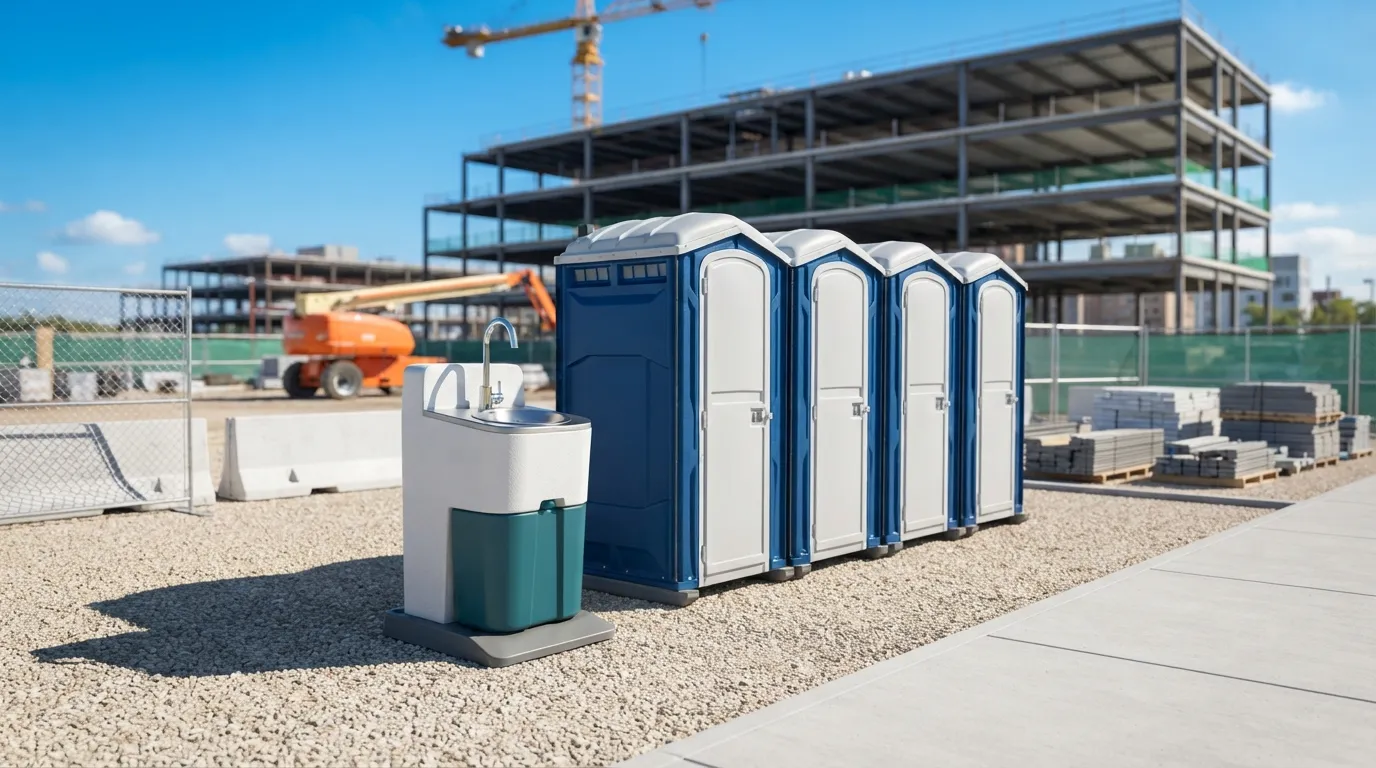
Where does relief sanitation get staged in Tacoma?
Placement depends on access, not just proximity to the affected block. A roll-off delivery needs about 60 feet of straight clearance behind the truck, which rules out some tight alleys and driveways during flood response. Standard unit placement should follow the same logic used for planned events, covered in the porta potty placement guide, with stable, level ground and a clear path in and out for service trucks.
Tacoma sits centrally enough that crews can reach most nearby cities within the hour: Fircrest is 4.1 miles southwest, University Place 6.8 miles southwest, Fife 7.2 miles east, and Lakewood 9.3 miles southwest. That radius matters when a disaster spans jurisdictions, since a flood or windstorm rarely respects a city line, and mutual aid staging areas often sit outside Tacoma proper. If a relief operation needs restrooms with real plumbing rather than standard units, a restroom trailer rental or shower trailer rental can support a longer-term shelter operation once the immediate crisis stabilizes.
| unit | duration | typical price |
|---|---|---|
| standard | day | $150 |
| standard | week | $200 |
| ada | day | $230 |
| septic | day | $250 |
| service_fee | day | $175 |
How much does disaster relief sanitation cost?
Pricing follows the same bands as any rental: a standard unit runs day, week or month rates, and a same-day emergency delivery often carries a service fee on top. See porta potty rental cost and porta potty rental per day for full breakdowns. Insurance or FEMA reimbursement questions should go through request a quote so documentation matches what's actually delivered.
Do you provide sanitation for shelters and staging areas?
Yes. Shelters typically need a mix of standard units, an ADA-compliant unit per ADA Standards 213.2, and handwashing stations sized to headcount. Larger shelters sometimes add a 4 stall restroom trailer or 8 stall restroom trailer if the deployment runs more than a few days.
Can you deliver during active flooding or storm conditions?
Access depends on road conditions, not willingness. If a site is reachable by delivery truck, Tacoma Porta Pros will move on it. Flooded or washed-out roads delay delivery until they're passable, so contact with real-time site conditions helps crews route around closures.
What happens if a septic system fails during a disaster?
A failed tank gets pumped or bypassed with a holding tank while repairs happen. Warning signs and immediate steps are covered in septic tank warning signs, and a residential tank normally needs pumping every 3 to 5 years even without an emergency accelerating it.
Do temporary fencing and lighting count as disaster relief services?
Yes, when they support the sanitation deployment or secure a staging area. Temporary fencing keeps donated supplies and equipment secured, and a light tower keeps night operations safe, both common additions alongside construction site services style deployments during longer relief efforts.
Next step
Get a delivery date
Tell us the address, the dates and the headcount. We size the order and confirm the route.